
Alexander & Sons Blog
How to Choose a Landscape Lighting Design for Your Backyard
The right landscape lighting design starts with identifying what you want to highlight — architecture, plantings, walkways, or gathering spaces — then layering different fixture types to create depth, rather than just lighting the whole yard evenly. Most well-designed backyards use a mix of path lighting, uplighting, and accent lighting rather than relying on one type of fixture throughout.
Here’s how to think through the decision.
Start With What You Actually Use the Space For
Before picking fixtures, think about how the backyard functions after dark:
- Entertaining and dining areas need brighter, more even light
- Walkways and steps need functional, safety-focused lighting
- Gardens, trees, and architectural features benefit from lower, more dramatic accent lighting
- Pools and water features often call for specialized fixtures rated for wet areas
A lighting plan that ignores how the space is actually used tends to either overlight the yard (flat, harsh, uninviting) or leave key areas dark and unsafe.
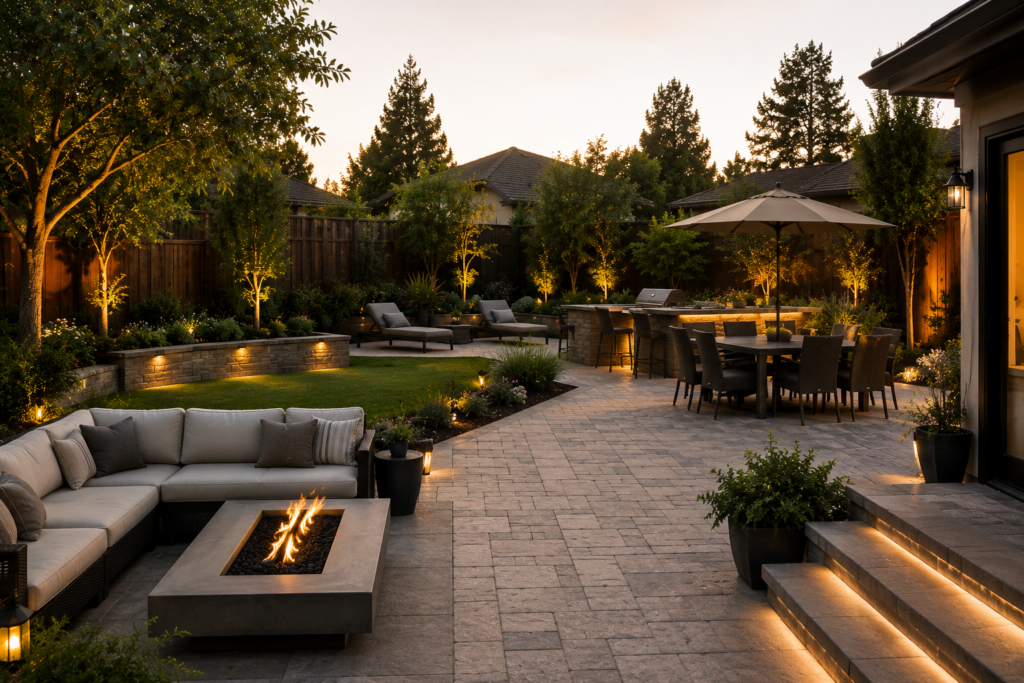
The Main Types of Landscape Lighting
Path Lights
Low, ground-level fixtures that line walkways and driveways for both safety and definition. These are usually the first thing homeowners think of, but they shouldn’t be the only layer.
Uplighting
Fixtures placed at the base of trees, columns, or architectural features, aimed upward to create dramatic shadow and highlight. This is what gives a yard depth after dark instead of flat, even light.
Downlighting / Moonlighting
Fixtures mounted higher — often in trees — and aimed downward to mimic natural moonlight. This creates soft, dappled light across patios and lawns.
Accent Lighting
Focused fixtures used to highlight a specific feature: a retaining wall, a piece of stonework, a water feature, or a specimen tree.
Step and Deck Lighting
Small, recessed or surface-mounted fixtures built into steps, walls, or deck edges for safety in transition areas.
Layout Principles That Make a Design Work
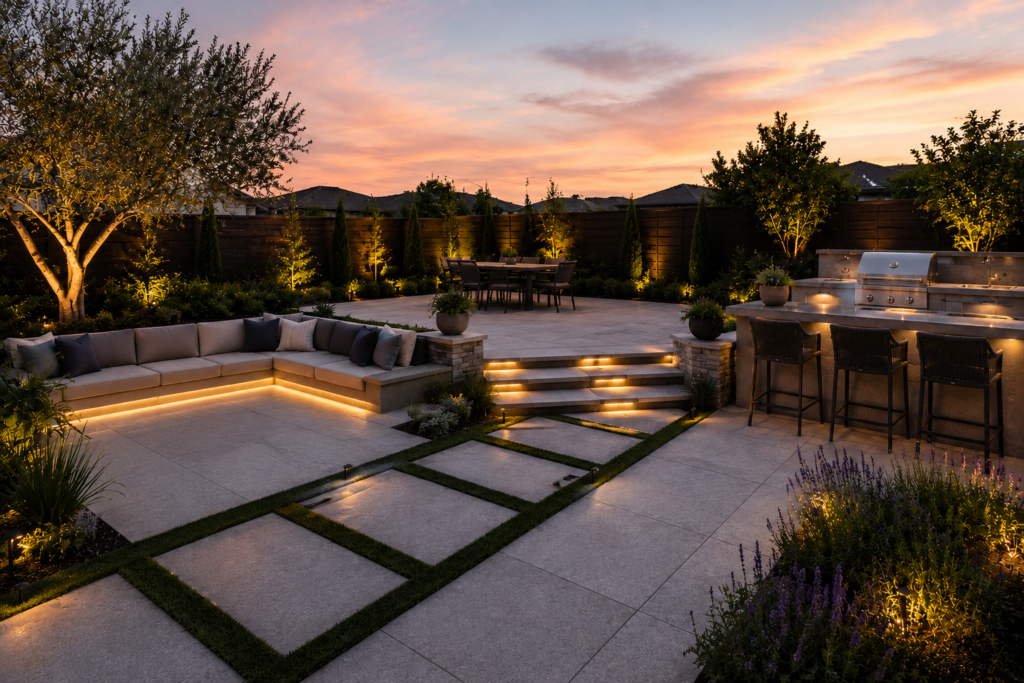
- Layer, don’t flood. Combining 2-3 fixture types at different heights creates a more natural, higher-end look than one uniform type of lighting across the whole yard.
- Avoid glare. Fixtures should be positioned so the light source itself isn’t directly visible from typical seating or walking areas.
- Highlight, don’t outline. Focus on 3-5 key features rather than trying to light everything — over-lighting a yard flattens it out and looks less intentional.
- Plan for control. Zoning your lighting (so path lights, accent lights, and entertaining-area lights can be controlled separately) makes the space far more usable night to night.
LED vs. Traditional Landscape Lighting
Most landscape lighting installed today uses low-voltage LED fixtures, which use significantly less energy than older halogen systems, run cooler, and last considerably longer — often 15,000-50,000+ hours depending on the fixture. The lower heat output also makes them safer near plantings and mulch.
Common Landscape Lighting Mistakes
- Too much light — washing out the yard instead of creating depth
- Wrong color temperature — overly cool, blue-white light instead of warm white, which reads more natural against landscaping
- Skipping the transformer/zoning plan — leads to a system that’s hard to expand or control later
- DIY wiring without a plan — inconsistent voltage drop across a run of fixtures leads to uneven brightness
Designed for How You'll Actually Use Your Yard
At Alexander & Sons, we design landscape lighting as part of the full outdoor space — not as an afterthought bolted on once the patio or landscaping is done. We’ve been building and lighting outdoor living spaces across Campbell, San Jose, Los Gatos, and the South Bay for over 20 years.
Want to see lighting options in person before you decide? Stop by our Campbell showroom to see fixture styles and warm vs. cool lighting comparisons firsthand, or call to schedule a free on-site consultation where we can walk your yard and show you exactly how a layered design would look.
📞 (408) 515-2525 — Free estimates 📍 Showroom & service area: Campbell, San Jose, Los Gatos & the South Bay 🕐 Showroom hours: Tue–Thu, 12–3pm
FAQ
What’s the difference between uplighting and downlighting in landscape design? Uplighting is placed at ground level and aimed upward to highlight trees or architectural features, while downlighting (or moonlighting) is mounted higher, often in trees, and aimed downward to create a soft, natural glow across the yard below.
Is LED landscape lighting worth it over traditional halogen? Yes — LED fixtures use less energy, run cooler, and typically last far longer than halogen, making them the standard choice for most new landscape lighting installations.
How many types of landscape lighting should a backyard have? Most well-designed backyards use 2 to 3 fixture types — such as path lighting, uplighting, and accent lighting — layered together rather than relying on a single fixture type throughout.
Welcome to the
Alexander & Sons Blog
From patios to driveways, your source for expert concrete and hardscape advice in Campbell, Los Gatos, Palo Alto, and beyond.