
Alexander & Sons Blog
Do I Need a Retaining Wall? Signs Your Bay Area Property Needs One
Quick answer: You likely need a retaining wall if your property shows any of these signs: visible soil erosion, sloped areas where water pools or runs off, leaning or failing fences, exposed tree roots, sinking patios or walkways, or a yard with more than a 3-foot grade change. In the Bay Area, retaining walls are especially common in hillside neighborhoods like Los Gatos, Saratoga, Almaden Valley, and parts of San Jose, where clay soil, seasonal rain, and seismic activity make slope stabilization critical. If you’re noticing these warning signs, scheduling a professional consultation before the problem worsens is the smartest move — early action almost always costs less than waiting until the slope fails.
If you live in the South Bay and own a home with any meaningful slope, drainage issue, or soil movement, you may need a retaining wall — but it’s not always obvious until problems start showing up. Unlike a driveway or patio replacement, retaining walls solve structural problems most homeowners don’t recognize until water is already pooling against the foundation, the fence is leaning, or the patio is sinking. This guide helps you identify whether your property actually needs a retaining wall, what kind, and what’s at stake if you wait.
What is a retaining wall and what does it do?
A retaining wall is a structure that holds back soil to prevent erosion, manage grade changes, and create usable flat space on sloped property. It’s both a functional and aesthetic feature: a properly built retaining wall stabilizes your yard while opening up new design possibilities like terraced gardens, level patios, or expanded driveways.
Retaining walls are typically built from:
- Concrete masonry units (CMU block) — most common, durable, often faced with stone veneer
- Poured concrete — strongest option for tall walls, can be stamped or finished decoratively
- Natural stone — premium look, longer install time
- Segmental retaining wall blocks — modular systems designed for mid-height walls
- Timber — lower-cost option but shorter lifespan in Bay Area moisture
In the South Bay, the right choice depends on wall height, soil conditions, drainage, and how the wall fits the surrounding landscape.
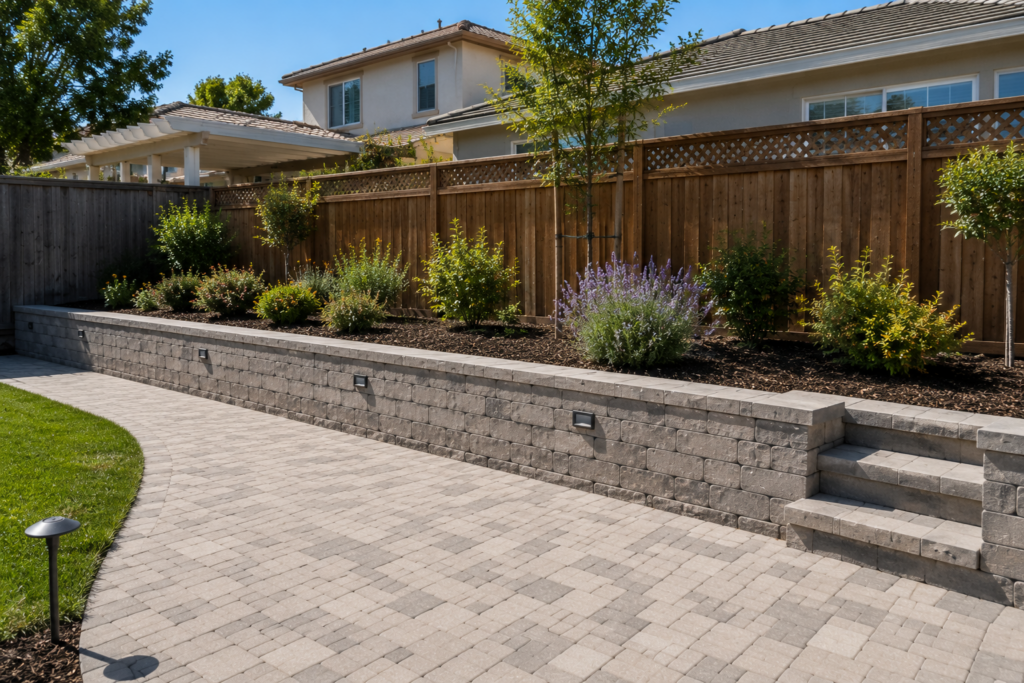
8 signs your Bay Area property needs a retaining wall
Here are the most common warning signs South Bay homeowners notice before realizing a retaining wall is needed:
1. Visible soil erosion or bare patches on slopes
If you see exposed dirt where grass or plants used to grow, or you’re regularly sweeping soil off your patio or driveway after rain, your slope is actively eroding. This typically gets worse season over season — what’s a small bare patch this year can be a serious washout in two or three years.
2. Water pooling against your foundation or in low spots
Bay Area homes built on sloped lots often develop drainage problems over time. If water collects against your foundation, in basement window wells, or in unexpected spots in the yard during rain, soil movement is likely involved. A properly designed retaining wall with drainage can redirect water away from problem areas.
3. A leaning or failing fence
This is one of the most reliable signs of slope failure. When a fence on a slope begins leaning downhill, cracking, or pulling away from posts, the soil beneath it is moving. A new retaining wall installed correctly can stabilize the slope and protect any future fence from the same fate.
4. Exposed tree roots or trees leaning downhill
Mature trees revealing more and more of their root systems above ground are a sign that soil is washing away around them. Trees leaning noticeably downhill on a slope often indicate the soil beneath them is shifting. Both are signs that grade stabilization is needed.
5. A sloped yard you can’t fully use
If a portion of your backyard is too steep to walk on comfortably, mow, or use for any purpose, a retaining wall can convert that wasted space into a usable flat area — a play space, garden, patio, or expanded entertaining area. In the South Bay’s tight residential lots, reclaiming sloped space significantly increases your home’s livable square footage.
6. Sinking, cracking, or shifting patios and walkways
Hardscape that’s sinking on one side, cracking diagonally, or pulling away from the house is often a symptom of soil instability. New retaining walls can be designed and installed alongside replacement hardscape so the underlying problem and the surface problem are solved together.
7. A grade change of 3 feet or more on your property
Any time there’s a vertical drop of three feet or more between two parts of your yard, a retaining wall is usually the right solution. Smaller grade changes can sometimes be managed with landscaping alone, but anything beyond 3 feet typically needs structural support to stay stable long-term — especially in earthquake country.
8. Plans to build a new patio, driveway, or addition on a sloped area
If you’re planning to add a patio, expand a driveway, build an outdoor kitchen, or add square footage to your home on a sloped portion of your property, a retaining wall is often required to create the level, stable foundation those projects need. Designing the retaining wall and the new feature together produces a better result than retrofitting later.
Why Bay Area properties need retaining walls more than most regions
Three regional factors make retaining walls especially important in the South Bay:
Expansive clay soil. Much of Santa Clara County, especially in foothill neighborhoods, sits on clay-heavy soil that expands when wet and contracts when dry. This constant movement gradually destabilizes slopes and can damage fences, driveways, patios, and home foundations. A properly engineered retaining wall accommodates this movement.
Seasonal heavy rain. The Bay Area’s rainy season (December through March) often delivers most of the annual rainfall in concentrated bursts. Sloped properties without proper grading and retention can experience rapid erosion during a single storm.
Seismic activity. Earthquake country requires retaining walls to be engineered to a higher standard than in most parts of the country. Walls over 4 feet tall almost always require permits, engineering, and inspection — and they should be designed to handle ground movement.
Hillside development. Many South Bay neighborhoods — Los Gatos, Saratoga, Almaden Valley, parts of San Jose, Cupertino, and Monte Sereno — are built on hillsides. These properties almost always benefit from professional grading and retaining wall systems.
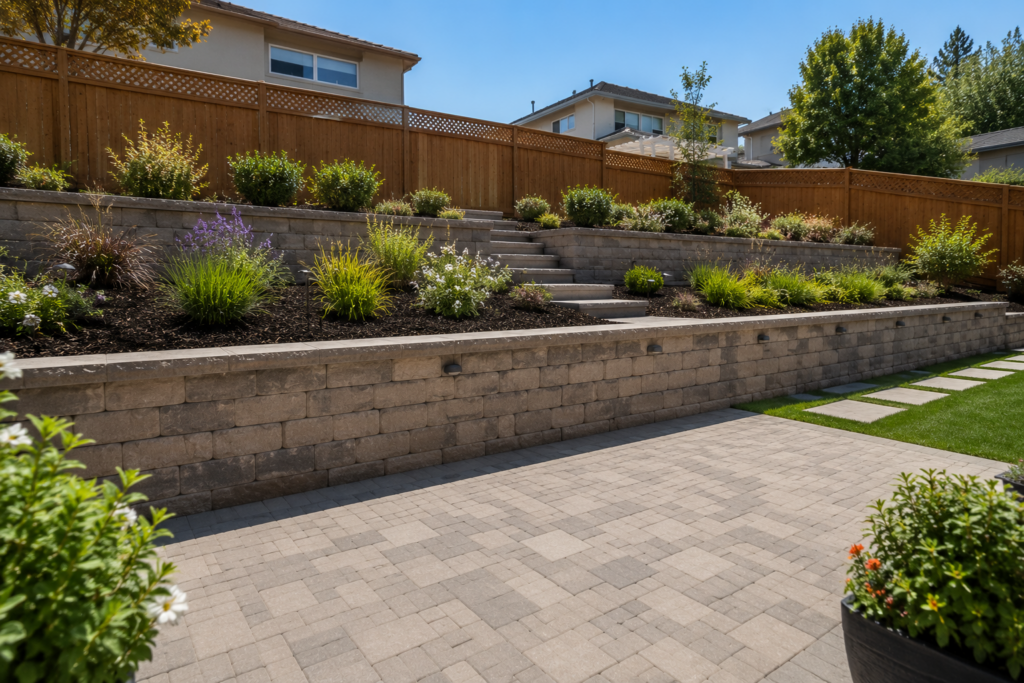
When to call a professional vs. handle it yourself
DIY retaining wall kits and segmental block systems are sold at home improvement stores, and for very small projects (under 2 feet, on stable flat ground, with no drainage concerns) they can be appropriate. However, for any of the following, you should bring in a licensed contractor:
- Walls over 3 feet tall — usually require permits and engineering in the South Bay
- Walls supporting a driveway, patio, or structure — load-bearing walls require engineered design
- Walls in earthquake or fire zones — code requirements are stricter
- Walls dealing with active drainage or erosion problems — these require integrated drainage solutions
- Walls on hillside or sloped lots — soil engineering matters
- Any wall connected to property line, neighbor’s property, or right-of-way — legal and engineering implications
What does a new retaining wall cost in the Bay Area?
Costs vary widely based on height, length, materials, drainage requirements, and site access. Realistic 2026 ranges for the South Bay:
- Standard CMU block wall, 3–4 feet tall: $50–$100 per square foot of wall face
- Decorative stone-faced or stamped concrete wall: $80–$150 per square foot
- Natural stone wall: $100–$200+ per square foot
- Tall engineered walls (5+ feet): $150–$300+ per square foot, plus engineering fees ($1,500–$5,000+)
A typical residential retaining wall project in the South Bay lands between $8,000 and $40,000, depending on size and design. Large hillside projects with engineering and drainage can run $50,000 to $150,000+.
Common questions homeowners ask
Do I need a permit for a retaining wall in San Jose? In most South Bay cities, retaining walls over 4 feet tall (measured from the bottom of the footing) require a building permit. Walls supporting a surcharge — like a driveway, structure, or sloped yard above — often require permits regardless of height. A licensed contractor will pull required permits as part of the project.
How long does a new retaining wall last? A properly designed and installed retaining wall in the Bay Area can last 50 to 100+ years. CMU block and poured concrete walls have the longest lifespans. Timber walls typically last 15 to 25 years before showing significant wear in our climate.
Does Alexander & Sons repair existing retaining walls? No. Alexander & Sons specializes in new retaining wall design and installation, including full replacement of failed or outdated walls. If your existing wall has minor cracks or surface issues, a repair specialist may be the right fit. If the wall has failed, is leaning, or needs to be removed and rebuilt, that’s where Alexander & Sons can help.
Can a retaining wall add value to my home? Yes. A well-designed retaining wall can increase usable yard space, improve curb appeal, and protect your home from soil and water damage — all of which contribute to property value. In the South Bay’s competitive market, structural stability and aesthetic landscaping both meaningfully affect resale price.
How long does it take to install a new retaining wall? Smaller walls (under 4 feet, under 30 feet long) typically take 1–2 weeks. Larger walls with engineering, drainage systems, and hillside conditions can take 4–8 weeks. Permit timelines add 2–6 weeks before construction begins.
Can a retaining wall be combined with other landscaping work? Absolutely. Many South Bay homeowners pair a new retaining wall with a patio, driveway, outdoor kitchen, terraced garden, or full backyard redesign. Designing these projects together produces a better-integrated result and often reduces total cost compared to phasing them separately.
What’s the difference between a retaining wall and a garden wall? A retaining wall holds back soil and manages grade changes. A garden or decorative wall is purely aesthetic and doesn’t bear structural loads. The two are sometimes combined, but the engineering requirements are very different.
Final thoughts
A retaining wall is one of those features homeowners rarely think about until they need one — and by then, the problem is often more expensive than it would have been if addressed earlier. If you’re seeing erosion, drainage issues, leaning fences, or grade changes that limit how you use your yard, a professional consultation is the right next step. The earlier the problem is identified, the more options you have for solving it.
If your existing retaining wall has failed, or you need a new wall installed as part of a larger landscape or hardscape project, Alexander & Sons designs and builds new retaining walls throughout the South Bay — from straightforward grade changes to complex hillside installations integrated with full backyard redesigns. Reach out for a consultation at alexandersons.com.
Welcome to the
Alexander & Sons Blog
From patios to driveways, your source for expert concrete and hardscape advice in Campbell, Los Gatos, Palo Alto, and beyond.