
Alexander & Sons Blog
How to Design an Outdoor Living Space for Year-Round Use in the Bay Area
Quick answer: Designing a year-round outdoor living space in the Bay Area means planning for three things: shelter from sun and light rain (covered patios, pergolas, or pavilions), warmth for cooler months (fire pits, outdoor heaters, or built-in fireplaces), and durable materials that hold up to coastal moisture and UV exposure. The South Bay’s mild Mediterranean climate makes year-round outdoor living more achievable here than almost anywhere else in the country — but it requires thoughtful design choices to make the space comfortable from January through December.
If you live in San Jose, Campbell, Los Gatos, Saratoga, Palo Alto, or anywhere in the South Bay, you’ve already got one of the best climates in the country for outdoor living. With 260+ sunny days per year, mild winters, and almost no extreme weather, your backyard can function as a true second living room — but only if it’s designed with the full calendar in mind, not just summer afternoons. This guide walks through what a true year-round outdoor space requires, how to plan it, and what it costs in the South Bay.
What makes the Bay Area ideal for year-round outdoor living?
The South Bay sits in a Mediterranean climate zone (Sunset Climate Zone 15–16 for most of San Jose, Zone 17 closer to the coast). Practically, that means:
- Mild winters: Average lows of 40–45°F in January, with rare frost
- Warm but not extreme summers: Average highs of 80–85°F, cooling significantly at night
- A defined wet season (December–March) with most rain falling in heavy bursts rather than constant drizzle
- Long shoulder seasons: Spring and fall offer the most comfortable outdoor weather of any region in the country
- Low humidity year-round, which makes both heat and cool feel less intense
This climate means with the right design, your outdoor space can be usable 320+ days per year — far more than a backyard in Sacramento, Phoenix, or anywhere east of the Sierras.
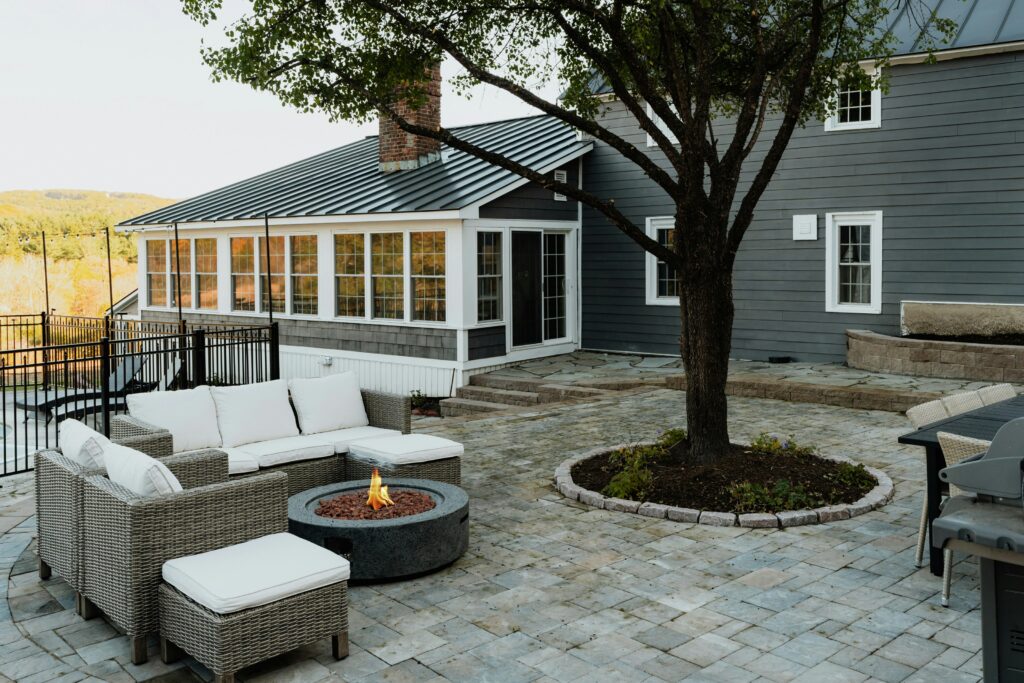
The 5 essential design elements for year-round Bay Area outdoor living
A truly year-round space combines five elements. You don’t need all of them, but the more you include, the more days per year your space gets used.
1. A defined “outdoor room” with structure
The foundation of year-round outdoor living is a clearly defined space — not just a slab of concrete, but a place that feels like a room. This usually means:
- A solid floor (paver patio, stamped concrete, flagstone, or composite deck)
- Vertical structure (pergola, pavilion, arbor, or partial walls) to anchor the space
- Clear edges (planters, low walls, level changes, or material transitions) that separate the living area from the rest of the yard
Pavers are the most popular flooring choice in the South Bay because they handle moisture well, don’t crack with soil movement, and work in almost any design style. Stamped concrete is a slightly more affordable option but doesn’t hold up as well over time in our soil conditions.
2. Shelter from sun and rain
A pergola, pavilion, or covered patio is what transforms an outdoor space from a “summer afternoon” feature to a year-round room. In the Bay Area, the main things you’re sheltering from are:
- Strong afternoon sun in summer (especially July–September)
- Light winter rain (most South Bay rain is brief, so a covered space stays usable)
- Morning and evening fog in cities closer to the coast
Pergolas offer partial shade and architectural style, and modern motorized louvered pergolas can fully close to block rain. Expect $8,000–$25,000+ for a quality pergola in the South Bay, depending on size and motorization.
Solid-roof pavilions offer full weather protection and dramatically expand the usable calendar. They typically run $15,000–$50,000+ installed and often require permits.
Cantilevered patio covers attached to the house are a more affordable middle ground at $5,000–$15,000.
3. Heat for cooler months
This is the single biggest factor in turning a 6-month space into a 12-month space. Bay Area winter evenings can drop into the 40s — too cold for most people to sit outside without heat, but easily addressable with the right setup.
Options, ranked by ambiance vs. utility:
- Built-in gas fireplace: The premium option. $8,000–$20,000+ installed, but creates a true room-like centerpiece
- Built-in fire pit: $3,500–$10,000+ depending on materials and gas vs. wood. Most popular South Bay option.
- Freestanding fire pit or chiminea: $300–$2,000. Easy add-on, doesn’t require permits.
- Overhead radiant heaters: $400–$1,500 per heater. Very effective for covered spaces.
- Patio heaters (propane or natural gas): $200–$800. Functional but less attractive.
Most South Bay outdoor living designs combine a built-in fire feature for ambiance with overhead heaters for cold winter nights.
4. Lighting designed for evening use
A space without proper lighting is a daytime-only space. Year-round outdoor living means designing lighting that makes the space feel inviting after 5 p.m. — which, in winter, is almost the entire usable evening.
Layered lighting works best:
- Ambient lighting (string lights, lantern-style fixtures, or pergola-mounted lights) for general illumination
- Task lighting at cooking and dining areas
- Path lighting along walkways for safety
- Accent lighting highlighting trees, water features, or architectural elements
Low-voltage LED systems are the standard in modern South Bay installations because they’re energy-efficient, safe, and easy to control. Expect $2,500–$8,000 for a complete landscape lighting system on a typical residential property.
5. Outdoor cooking and entertaining capability
If you want the space to function as a true second living room, it needs a reason to draw people outside year-round. For most homeowners, that’s outdoor cooking.
Some options:
- Built-in BBQ island with counter
- Full outdoor kitchen Pizza oven addition:
- Simple grill station:
In the Bay Area, outdoor kitchens are increasingly designed with weather protection (covered or pergola-shaded) and gas connections rather than propane, so they’re usable year-round.
Designing for the Bay Area's specific challenges
A few regional considerations affect how you design a year-round space:
Wildfire awareness. Many South Bay homes, especially in foothill and hillside areas (Los Gatos, Saratoga, Almaden Valley), sit in or near Wildland-Urban Interface zones. This affects material choices: avoid combustible mulches near fire features, use ember-resistant construction, and follow defensible space guidelines. Your contractor should know local fire code requirements.
Drought and water conservation. California’s ongoing drought conditions affect landscape choices. Many homeowners pair their outdoor living spaces with drought-tolerant plantings, artificial turf, or permeable paver surfaces that comply with stormwater regulations.
Earthquake and soil considerations. The Bay Area’s clay soils and seismic activity affect how built-in features (especially heavy stone fireplaces and walls) need to be engineered. Proper footings and reinforcement aren’t optional.
Neighbor proximity. Most South Bay homes sit on smaller lots than national averages. Design choices like screening plants, partial walls, and strategic pergola placement matter more here than in regions with bigger yards.
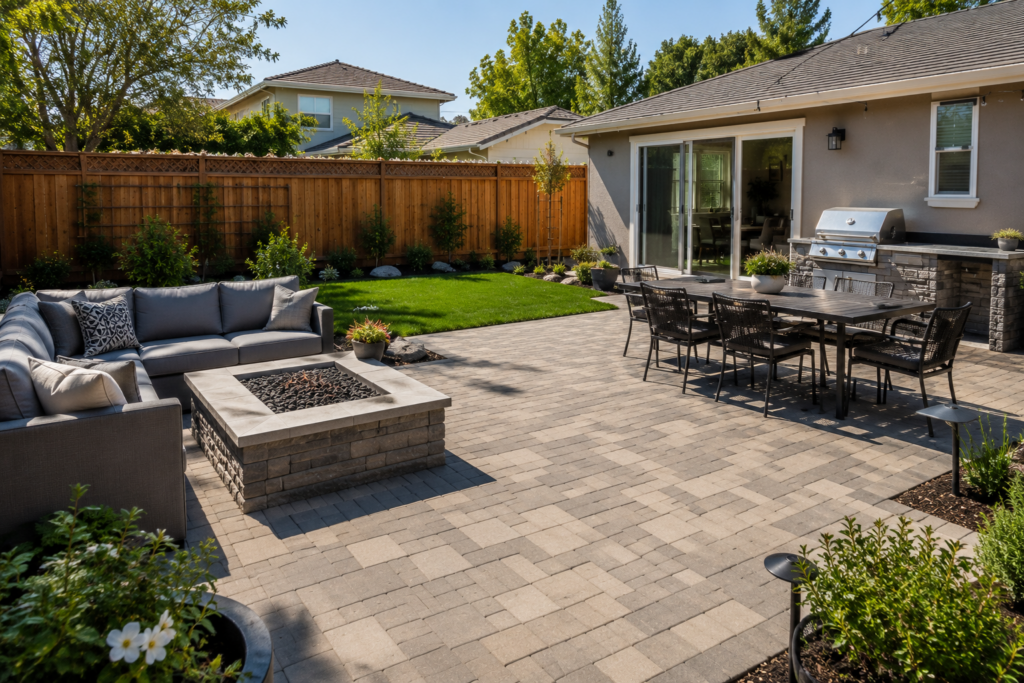
What does a complete year-round outdoor living space cost?
Total project costs vary widely based on size and material choices. Realistic ranges for a complete South Bay project:
- Entry-level (paver patio + pergola + fire pit + lighting): $25,000–$45,000
- Mid-range (paver patio + pavilion or motorized pergola + built-in fire feature + outdoor kitchen + lighting): $60,000–$120,000
- High-end (full outdoor room with fireplace, kitchen, lighting, water features, and premium materials): $150,000–$400,000+
A full backyard redesign typically takes 6–12 weeks from design to completion, depending on permits and scope.
Common questions homeowners ask
Can I really use my outdoor space year-round in the Bay Area? Yes — with the right design. Most properly equipped South Bay outdoor spaces get used 300+ days per year. The limiting factor is rarely temperature; it’s whether the space has shelter, heat, and lighting.
Do I need a permit for an outdoor living space in San Jose? It depends on what you’re building. Patios at grade typically don’t require a permit. Pergolas, pavilions, attached structures, gas lines for kitchens or fire features, electrical work, and any structure over 120 square feet usually do. A licensed contractor will pull all required permits.
What’s the most cost-effective way to make my existing patio year-round? Adding heat and shelter delivers the biggest jump in usable days. A pergola with overhead heaters and a freestanding fire pit can transform a basic patio into a year-round space for $8,000–$15,000.
Is it better to add to my existing patio or start over? If your existing patio has good drainage, level conditions, and durable material (pavers in good shape, solid concrete without major cracks), adding to it is usually more cost-effective. If the existing surface is failing, starting over is the better long-term investment.
How long does an outdoor living space project take? Design and permits typically take 2–6 weeks. Construction ranges from 2 weeks for a simple patio with pergola to 8–12 weeks for a full outdoor kitchen with built-in features. Most South Bay homeowners plan 3–6 months from initial consultation to finished project.
What materials hold up best in Bay Area weather? Pavers, natural stone, exposed aggregate concrete, and stainless steel (for kitchens) are the most durable. Avoid materials that warp with humidity (low-grade composites), fade quickly in UV (some softwood furniture), or crack with soil movement (poured concrete in clay-heavy areas).
Should I build before or after landscaping? Hardscape (patios, walls, structures) goes in before plantings. The order is: design → permits → demolition → grading → hardscape → utilities (gas, water, electrical) → landscape lighting → planting → finishing touches.
Final thoughts
The Bay Area is one of the rare places in the U.S. where year-round outdoor living isn’t a stretch — it’s just a matter of design intent. The homeowners who get the most use out of their outdoor spaces are the ones who plan for January nights, not just July afternoons. That means thinking about heat, light, shelter, and durability from day one rather than adding them later.
If you’re considering a full outdoor living space and want to walk through what’s possible for your home, Alexander & Sons designs and builds custom outdoor environments throughout the South Bay, with a showroom in Campbell where you can see paver, stamped concrete, masonry, and material options in person. Reach out for a consultation.
Welcome to the
Alexander & Sons Blog
From patios to driveways, your source for expert concrete and hardscape advice in Campbell, Los Gatos, Palo Alto, and beyond.